Cersaie 2026 drew to a close, reaffirming its strength and its position as a leading international event for the ceramic industry, design and architecture.
The 43rd edition, held at BolognaFiere from 21 to 25 September, recorded 92,352 visitors, a modest decline of 2.4% compared with 2025. The event’s international reach remained particularly significant, with 44,500 international visitors, accounting for 48.2% of the total, and 233 international exhibitors from 24 countries.
Across 16 exhibition halls covering 145,000 square metres, a total of 595 companies showcased products and solutions spanning ceramic tiles, bathroom furnishings, raw materials, new surfaces, technologies and services.
These figures are particularly meaningful at a challenging time for the industry, marked by high energy costs, competitive pressures and uncertainty in international trade. Against this backdrop, Cersaie’s ability to maintain broadly stable attendance confirms its importance as a meeting point for industry, markets and the design community.
Yet Cersaie is more than a commercial showcase. The 2026 edition also highlighted how the industry is redefining the very concept of the ceramic surface, with research increasingly focused on materiality, three-dimensional design, tactile qualities, depth and interaction with light.
TABLE OF CONTENTS
- Cersaie 2026: a resilient industry continuing to invest in innovation
- The value of Made in Italy in the ceramic industry
- From graphics to materiality: how ceramic surfaces are evolving
- Increasingly tactile, textured and sensory ceramic surfaces
- Sicer’s research at Cersaie 2026: structure, finish and depth
- UNDERSKIN: creating three-dimensional effects through structure
- NEXT: materiality, tactile qualities and light reflection
- IPOGEO: from natural materials to ceramic reinterpretation
- Beyond Cersaie 2026: new directions for ceramic surfaces
- FAQ
Cersaie 2026: a resilient industry continuing to invest in innovation
One of the clearest themes to emerge from the event was the relationship between competitiveness and the ability to innovate.
Energy, the focus of the opening conference, “Sustainable Energy for Competitiveness”, remains one of the main challenges facing the ceramic industry. Rising energy costs and EU Emissions Trading System (ETS) allowance costs directly affect companies’ ability to sustain investment and remain competitive in international markets.
At the same time, the strong presence of international buyers, industry professionals, architects and designers reinforces the importance of research and innovation in differentiating ceramic products.
In this context, the surface is taking on an increasingly central role: no longer simply a substrate for decoration, but the result of a system in which materials, application technologies, structure and performance must be developed together.
The value of Made in Italy in the ceramic industry
Against an international backdrop of high energy costs, market instability and new competitive challenges, Made in Italy remains a distinctive strength of the ceramic industry.
As Gianfranco Padovani, President of Sicer, emphasised in an interview with Ceramicanda during Cersaie 2026, the strength of the Italian ceramic industry lies above all in its accumulated expertise and capacity for innovation. Even as production volumes decline, the ability to create value remains central to the competitiveness of Italian ceramics.
In this context, research, know-how and technological development play a fundamental role, enabling companies to differentiate themselves and continue bringing new solutions to international markets.
From graphics to materiality: how ceramic surfaces are evolving
One of the clearest developments at Cersaie 2026 was the evolution of material-led design. Ceramics continue to draw inspiration from marble, stone, concrete and other natural materials, but achieving a convincing interpretation is no longer simply a matter of graphics and colour.
Surface design increasingly incorporates relief, texture, depth, tactile qualities and interaction with light. The surface structure may follow the decorative pattern, enhance it or become a defining feature of the material itself.
Three-dimensionality therefore plays an increasingly important role in design. It introduces variations in light and shadow, changes how the surface is perceived and helps create a more realistic, sensory result.
This development reflects a broader shift towards ceramic surfaces designed to be seen, touched and experienced, where aesthetics and technology are becoming ever more closely connected.
Increasingly tactile, textured and sensory ceramic surfaces
Materiality was a recurring theme not only across the exhibition stands but also throughout the cultural programme at Cersaie 2026.
Discussions on architecture, design practice and new applications for ceramics reflected growing interest in materials capable of establishing a more complex relationship with the spaces they occupy.
The surface thus becomes an active design element: texture influences how light behaves, relief creates depth, finishes affect reflection and tactile qualities, while graphics and colour complete the overall visual impression.
The aim is therefore not simply to add a decorative effect, but to develop the surface through several interconnected design elements.
The solutions presented by Sicer at Cersaie 2026 can also be understood within this broader evolution.
Sicer’s research at Cersaie 2026: structure, finish and depth
At Cersaie 2026, Sicer presented different interpretations of contemporary ceramic surfaces, united by a common focus: exploring materiality and depth.
Among the featured solutions, UNDERSKIN, NEXT and IPOGEO each approach surface design in a different way.
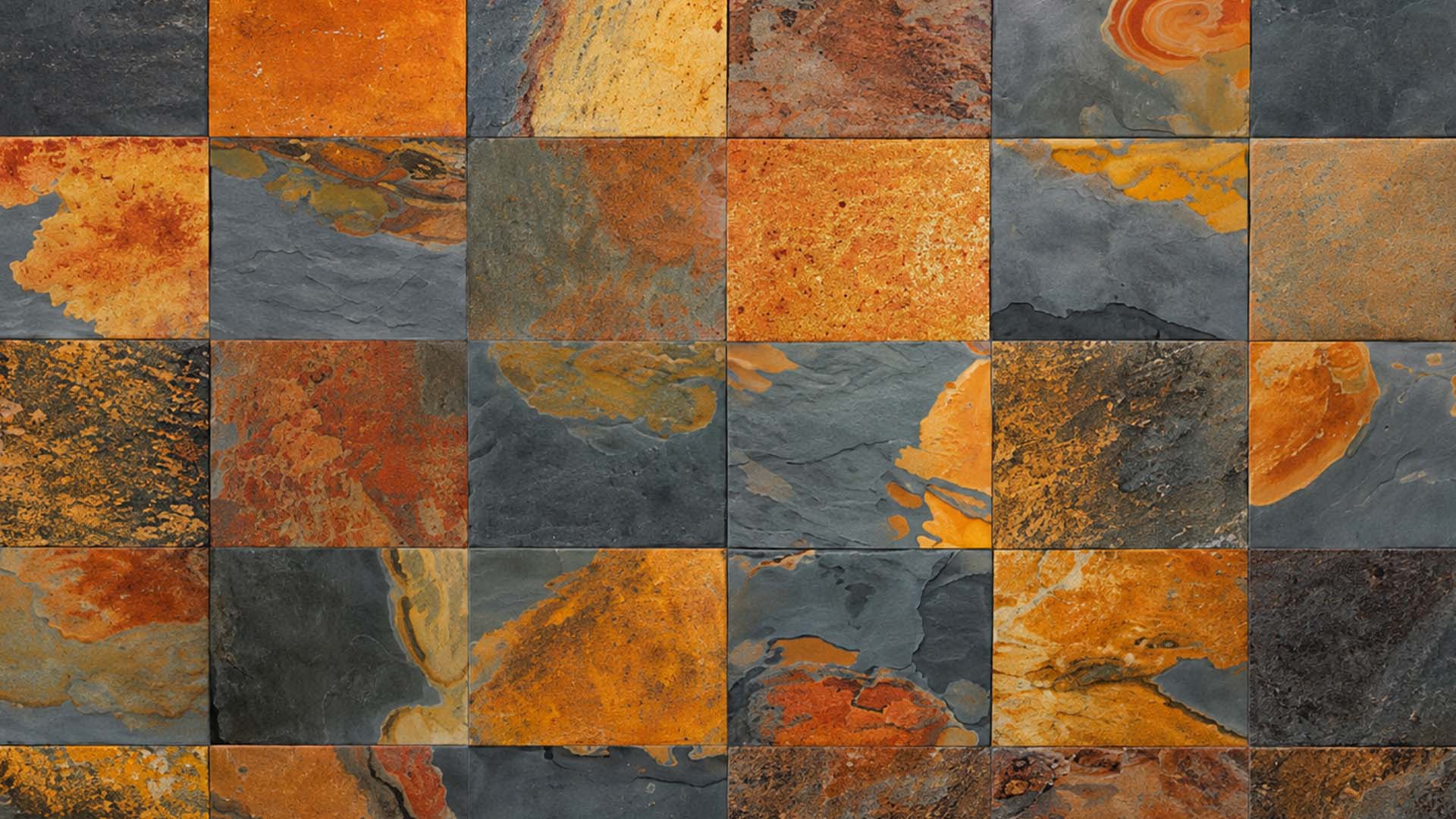
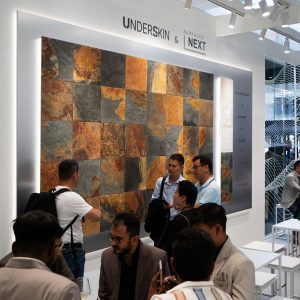
UNDERSKIN focuses on creating structure and relief from the earliest stages of the production process.
NEXT works at the finishing stage, exploring the relationship between materiality, tactile qualities and controlled light reflection.
IPOGEO, developed through a dialogue with natural materials, explores the relationship between the depth of marble and its reinterpretation in ceramics.
These three approaches reflect a shared direction in research: moving beyond a purely graphic understanding of ceramic surfaces to explore their physical, sensory and material qualities.
UNDERSKIN: creating three-dimensional effects through structure
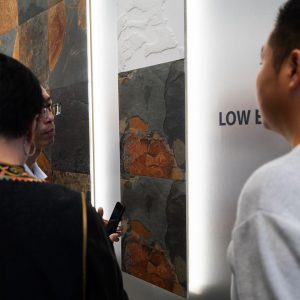
One of the strongest trends at Cersaie 2026 was the growing emphasis on three-dimensionality, reflecting a shift from predominantly graphic surfaces towards designs that also consider their physical structure.
UNDERSKIN, Sicer’s application technology, responds to this shift by developing surface structure from the earliest stages of the production process. Relief is therefore not treated as an additional decorative element, but as an integral part of how the surface is built.
This approach is particularly relevant when interpreting stone and other natural materials, where depth depends not only on the graphic representation of veining but also on the relationship between structure, graphics and materiality.
UNDERSKIN offers one response to the industry’s growing interest in ceramic surfaces with greater depth and a stronger material identity, achieved through controlled relief. At Cersaie 2026, Sicer presented the technology as a way of bringing structure, decoration and materiality into closer dialogue.
→ Explore UNDERSKIN technology
NEXT: materiality, tactile qualities and light reflection
Alongside three-dimensional design, Cersaie 2026 highlighted growing interest in surfaces whose material qualities are also shaped by how their finishes interact with light and touch.
NEXT Surfaces takes a different approach to materiality, focusing not on creating relief but on controlling the finish and the way the surface is perceived.
The technology uses carefully calibrated micro grits to create matt, anti-reflective surfaces with a natural appearance, where reduced light reflection helps bring out texture, colour and structure.
Within the context of Cersaie, the design value of NEXT lies in the balance between materiality, visual uniformity and tactile quality. This reflects the broader move towards sensory ceramic surfaces, where aesthetic qualities emerge from the interaction between the material and how it is experienced.
IPOGEO: from natural materials to ceramic reinterpretation
A third direction concerns the relationship between natural materials and ceramic design.
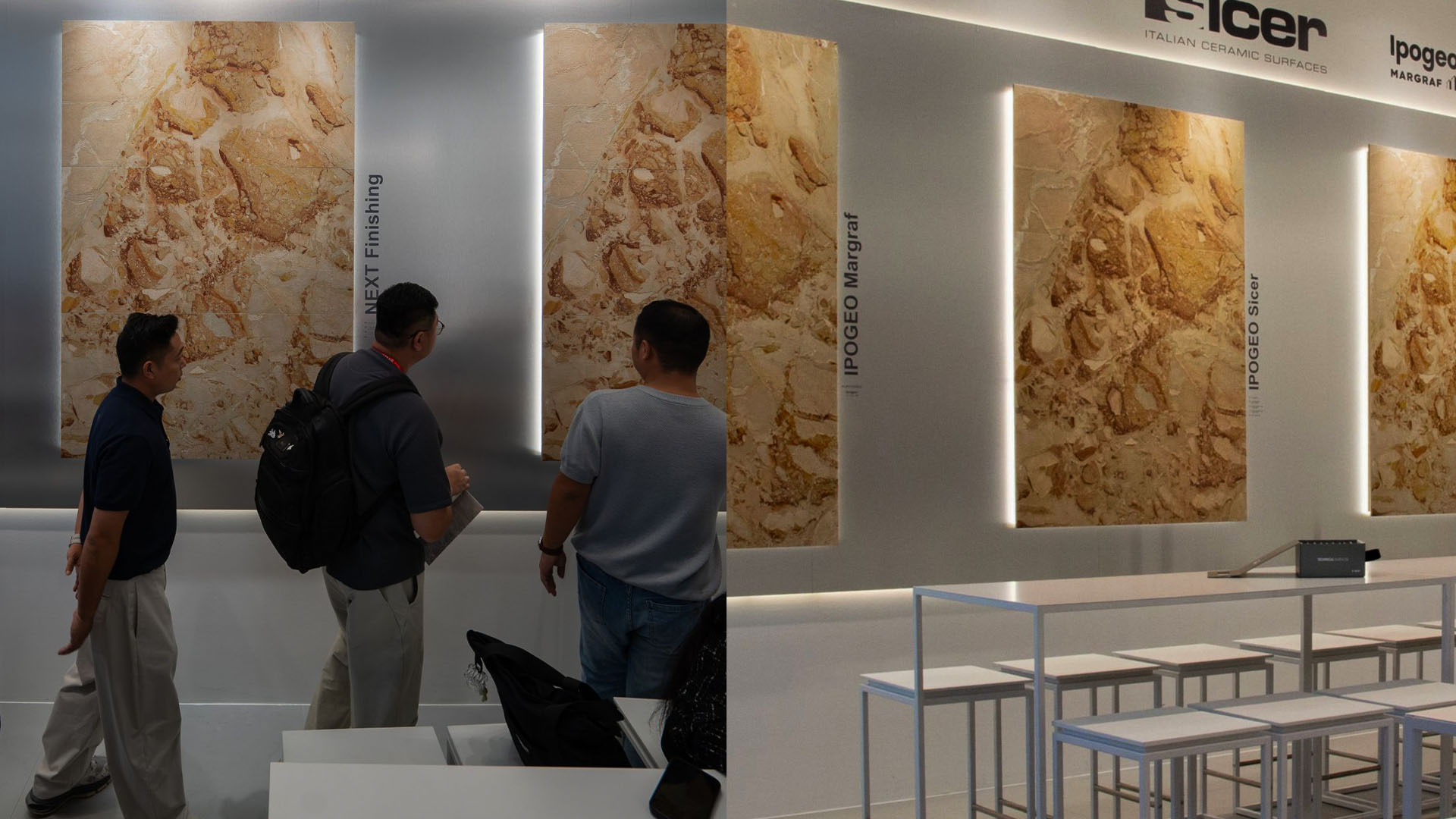
With IPOGEO by Margraf, presented at the Sicer stand during Cersaie 2026, the starting point is Alma Fuoco, an Italian marble sourced from a quarry exclusively owned by Margraf. Sicer reinterprets its distinctive character through ceramic technology and different finishes, including the IPOGEO surface.
The project takes a different approach from UNDERSKIN and NEXT. Here, research begins not only with an application technology but also with the study of a natural material, seeking to translate its character, depth and sensory qualities into a new ceramic language.
IPOGEO demonstrates how contemporary ceramics can move beyond simply imitating marble. Instead, the natural material becomes a design reference, interpreted through research, finishing technologies and ceramic expertise.
This dialogue between marble and ceramics connects the project with one of the most interesting trends at Cersaie: the development of surfaces that retain a strong connection with their natural inspiration while establishing an identity of their own.
Beyond Cersaie 2026: new directions for ceramic surfaces
Cersaie 2026 confirmed a clear direction: ceramic surfaces are increasingly being designed around materiality, three-dimensionality, finishes and tactile qualities.
In this context, UNDERSKIN, NEXT and IPOGEO represent three different approaches to surface research, united by the aim of expanding the expressive and technical possibilities of ceramics.
Looking for a partner to develop new ceramic surfaces?
Sicer works alongside ceramic manufacturers to develop customised solutions, bringing together material research, application technologies and specific production requirements.
→ Discover Sicer’s Bespoke Consulting service
FAQ
Cersaie 2026 highlighted continued interest in textured and three-dimensional ceramic surfaces, relief effects and finishes that enhance the relationship between materials, light and touch. Ceramic surface design is increasingly bringing together graphic decoration and the physical characteristics of the material.
Relief introduces a physical dimension that changes how a surface is perceived. Structure, light and shadow can enhance the sense of depth and interact with graphics and finishes, expanding the design possibilities of ceramics.
Among the solutions showcased by Sicer at Cersaie 2026 were UNDERSKIN, NEXT and IPOGEO. These three projects explore materiality from different perspectives: three-dimensional structure, surface finishes and sensory qualities, and the ceramic reinterpretation of natural materials.
Research is no longer focused solely on reproducing colours and graphics. Texture, relief, depth, finishes and interaction with light are playing an increasingly important role in the ceramic reinterpretation of stone, marble and other natural materials, helping to create surfaces with richer visual and tactile qualities.
Research makes it possible to align materials, formulations and application technologies with the aesthetic and technical objectives of each project. Moving from experimentation to production also requires solutions to be evaluated against the industrial conditions in which they will be used.