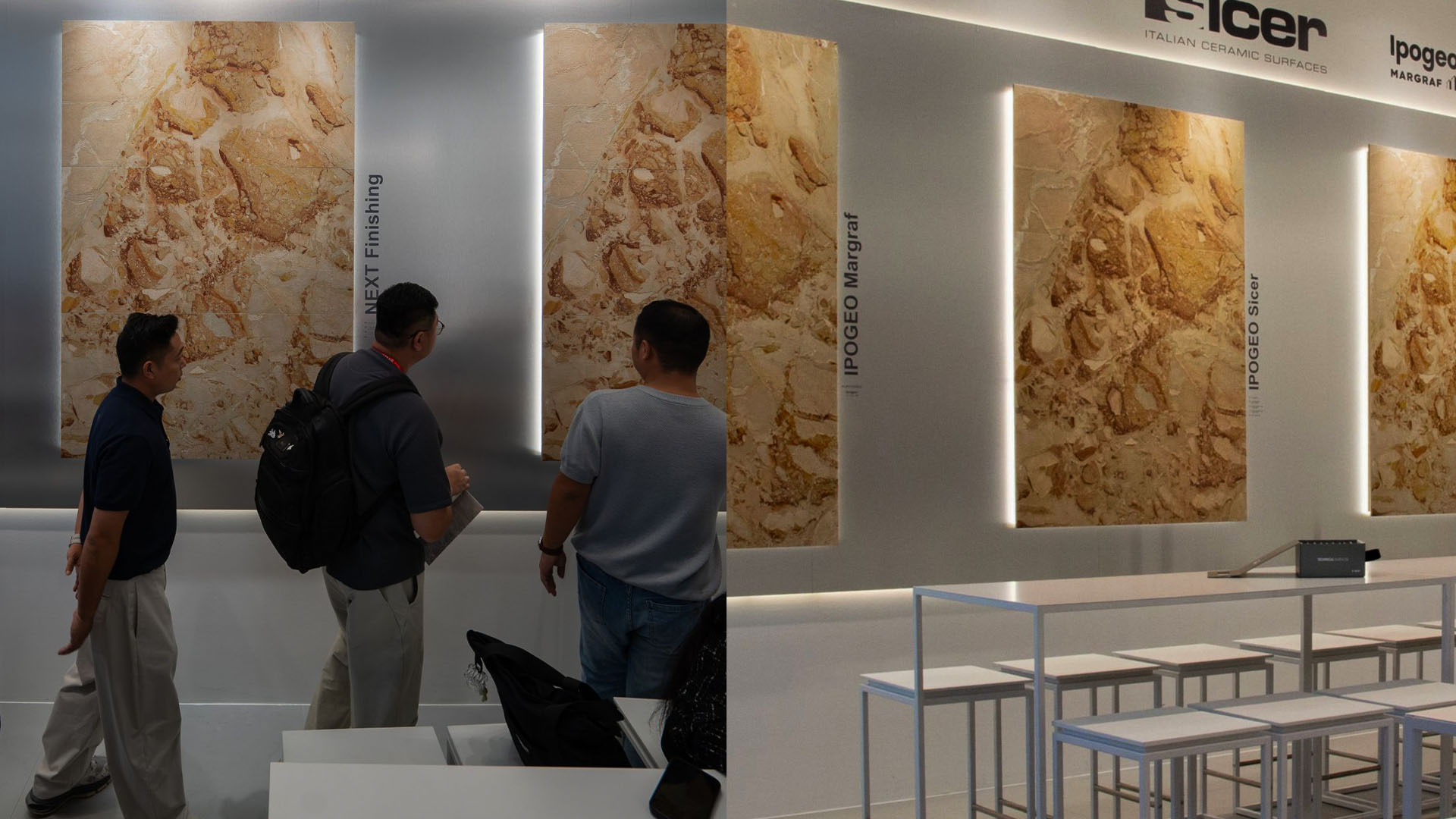

Contemporary ceramic surfaces are defined by more than the quality of their digital graphics. The final result is also determined by the way the surface interacts with light.
Depth, gloss, natural appearance and visual uniformity depend on the balance between glazes, digital inks, the firing cycle and the materials that make up the surface layer. Among these, ceramic grits play a key role, helping to determine how light behaves and, consequently, how the finished surface is perceived.
Transparent and anti-reflective ceramic grits meet different design requirements: transparent grits enhance graphic definition and surface depth, while anti-reflective grits control light diffusion to create more natural and uniform finishes.
Understanding how they work, and which variables influence their performance, is essential when developing increasingly advanced surfaces in which aesthetics, materials research and industrial reliability work together.
TABLE OF CONTENTS
- The optical response of a ceramic surface: the role of ceramic grits
- Transparent ceramic grits: controlling light transmission and enhancing graphics
- Anti-reflective ceramic grits: controlled light diffusion and visual uniformity
- How to choose between transparent and anti-reflective ceramic grits
- What influences the optical behaviour of ceramic grits
- Why particle size distribution influences a surface’s optical response
- From micro grit research to anti-reflective surfaces: NEXT EXPERIENCE SURFACES
- Conclusions
- FAQ
The optical response of a ceramic surface: the role of ceramic grits
When looking at a ceramic surface, colour and graphics are only part of what we perceive. The sense of depth, gloss, the natural appearance of a matt finish and the definition of veins all depend on the way light interacts with the surface layer.
Within this balance, ceramic grits play a fundamental role. Their characteristics influence the reflection, diffusion and transmission of light, helping to define the surface’s visual identity. This makes them one of the key design variables when developing a new ceramic collection.
The final result, however, never depends on a single element. The composition of the glassy phase, particle size distribution, fusibility, compatibility with glazes and digital inks, applied particle size and firing cycle all contribute to the behaviour of the finished surface.
Consider, for example, two ceramic tiles featuring the same digital graphic. If one is designed to reproduce polished marble, enhancing depth and gloss will be particularly important. If the aim is to recreate quartzite or natural stone, light reflection will need to be controlled to achieve a softer, more natural and realistic appearance. The graphic may be identical, but the final result can change significantly depending on the ceramic grits used and the balance of the entire application system.
For Sicer, surface design means precisely this: developing materials that work in synergy with glazes, digital decoration and application technologies, so that the desired aesthetic result can be reproduced consistently on an industrial scale.

Transparent ceramic grits: controlling light transmission and enhancing graphics
Transparent ceramic grits are used to enhance digital decoration and increase the perceived depth of a surface. During firing, they develop a glassy layer that promotes light transmission, enhancing textures, veins and graphic details.
They are particularly suited to marble-effect surfaces and polished or high-gloss finishes, where graphic definition and colour development are central to the overall aesthetic.
The final result also depends on compatibility with glazes and digital inks, application weight, application technology and the firing cycle. Achieving the right balance between these factors makes it possible to produce uniform surfaces with consistent, repeatable results on an industrial scale.
Anti-reflective ceramic grits: controlled light diffusion and visual uniformity
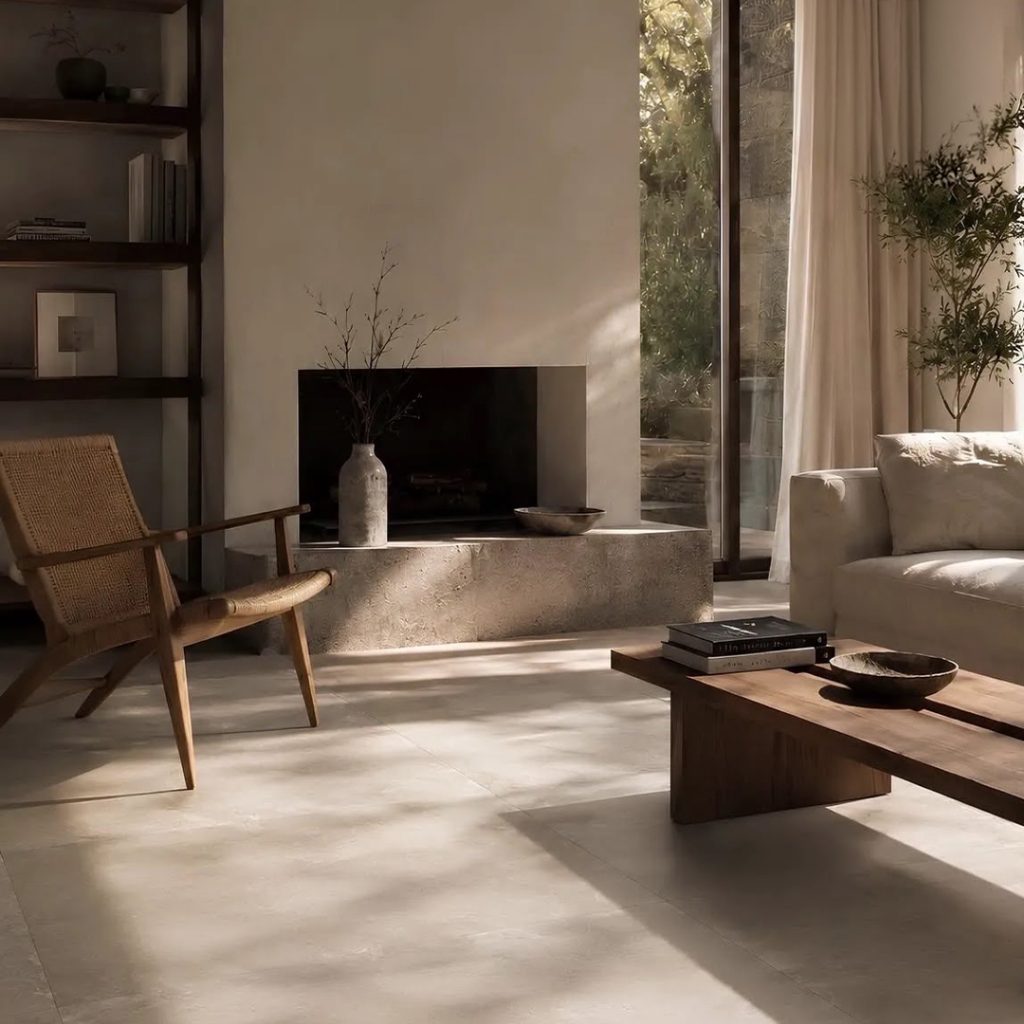
Anti-reflective ceramic grits are designed to reduce specular reflection and promote more uniform light diffusion.
They are particularly suitable for matt surfaces and interpretations of stone, concrete and other textural materials, where preserving the natural appearance of the graphic is essential, even under intense or changing lighting conditions.
The surface therefore appears more uniform when viewed from different angles, while textures and graphic details remain clearly visible. Here too, formulation, particle size distribution, glazes and firing parameters need to be developed as an integrated system to ensure both aesthetic consistency and production stability.
How to choose between transparent and anti-reflective ceramic grits
The choice depends first and foremost on the desired aesthetic effect.
Transparent ceramic grits are generally more suitable when the aim is to enhance graphics, increase visual depth and create greater surface gloss. An anti-reflective formulation is preferable when the objective is to control light and achieve a more natural and uniform appearance.
The choice must also take into account the ceramic body, glazes, application technology and firing cycle. Some projects may require an intermediate solution capable of combining visual depth, controlled reflection and a natural finish.
What influences the optical behaviour of ceramic grits
The optical behaviour of ceramic grits depends on their physical and chemical characteristics and on the way these interact with the other elements of the surface.
Key factors include the composition of the glassy phase, refractive index, compatibility with glazes and digital inks, and the material’s behaviour during firing. Particle size distribution, application uniformity and integration with the surface layers also contribute to the final result.
Achieving consistent results therefore requires more than developing a grit with the desired aesthetic properties. Its formulation must remain stable throughout the production process, minimising variations between batches and ensuring uniformity even in large-scale manufacturing.
Beyond their visual contribution, ceramic grit formulations can also help provide specific technical surface properties, including resistance to abrasion and scratching, which are particularly important in applications subject to wear and foot traffic.
Why particle size distribution influences a surface’s optical response
Particle size distribution directly affects the way ceramic grits are distributed, melt and integrate into the surface layer during firing.
The size and distribution of the particles influence the continuity of the glassy phase and the way light is reflected or diffused. A controlled particle size distribution helps achieve a more uniform finish and greater consistency in the final aesthetic effect.
Particle size must also be defined according to the requirements of each project. A marble-effect surface, for example, may require different characteristics from a stone-effect or concrete-effect finish, or from a technical ceramic surface.
Research into ceramic grits therefore involves not only chemical composition but also precise control over particle size and distribution. The aim is to develop surfaces that meet the desired aesthetic requirements while remaining easy to industrialise and consistent over time.

From micro grit research to anti-reflective surfaces: NEXT EXPERIENCE SURFACES
The evolution of ceramic surfaces is driven by increasingly advanced research into materials and their behaviour throughout the production process. Within this field, ceramic micro grits represent a particularly interesting area of development, as they make it possible to precisely control the aesthetic response of a surface without compromising industrial stability.
Sicer‘s experience in the formulation of ceramic grits and vitrified materials has led to the development of NEXT EXPERIENCE SURFACES, a solution based on a special blend of micro grits designed to create natural-looking surfaces with controlled reflections, high visual uniformity and a pleasant tactile quality.
Research is not focused solely on reducing gloss, but on controlling the interaction between light and the ceramic surface. The aim is to enhance graphics, structure and material effects, recreating the appearance of natural stone, quartzite, concrete and contemporary materials with a high degree of visual realism.
This approach enables manufacturers to develop collections that combine material research, production reliability and aesthetic consistency, meeting growing market demand for increasingly realistic ceramic surfaces.
With NEXT EXPERIENCE SURFACES, the matt, anti-reflective effect is also combined with functional properties such as ease of cleaning, chemical resistance and slip resistance, with solutions capable of achieving ratings from R9 to R12.
Conclusions
Transparent and anti-reflective ceramic grits offer different yet complementary design possibilities. Transparent grits enhance depth, gloss and graphic definition, while anti-reflective grits control light diffusion to create more natural and uniform surfaces.
Choosing the most appropriate solution does not depend on a single material, but on the balance between formulation, application technology, production process and the desired aesthetic result.
Developing a ceramic surface therefore requires expertise that brings together materials research, knowledge of industrial processes and application support. This integrated approach makes it possible to transform a design concept into a stable, repeatable production process capable of maintaining the desired aesthetic and technical characteristics over time.
Looking to develop a ceramic surface with specific aesthetic and technical characteristics? Every project requires a different balance between materials, application technologies and production processes. Sicer works alongside ceramic manufacturers to develop customised surfaces, identifying the most appropriate solutions to achieve the desired aesthetic effect with consistent results and industrial reliability.
→ Discover Sicer’s Bespoke Consulting service https://www.sicer.it/en/consulting-bespoke-ceramic-surfaces/
FAQ
Transparent ceramic grits are particularly suitable when the aim is to enhance digital decoration, increase surface depth and improve gloss and graphic definition. They are commonly used for marble-effect surfaces and polished or high-gloss finishes.
Anti-reflective ceramic grits reduce specular reflection and promote more uniform light diffusion. They are particularly suitable for stone-effect, concrete-effect and other natural-looking surfaces, helping to maintain a balanced appearance even in brightly lit environments.
Yes. Particle size distribution influences how ceramic grits are distributed, the formation of the glassy phase and the way light interacts with the surface. Controlled particle size distribution helps achieve more uniform finishes and consistent aesthetic results.
The visual appearance of a ceramic surface results from the interaction between ceramic grits, glazes, digital inks, application technology and the firing cycle. Each element contributes to defining gloss, depth, uniformity and the natural appearance of the finished surface.
Yes. Depending on their formulation, ceramic grits can contribute not only to the aesthetic result but also to properties such as abrasion resistance, scratch resistance, ease of cleaning and slip resistance. These characteristics must be assessed according to the intended use of the surface and the application system.